
Statistical accounting is considered to be an effective means of systematization and development of prospects for the activity of economic entities.
Emomali Rahmon
THE HISTORY OF THE ORIGIN OF THE NATIONAL CURRENCY Respect for the national currency is respect for the nation!
30.10.26
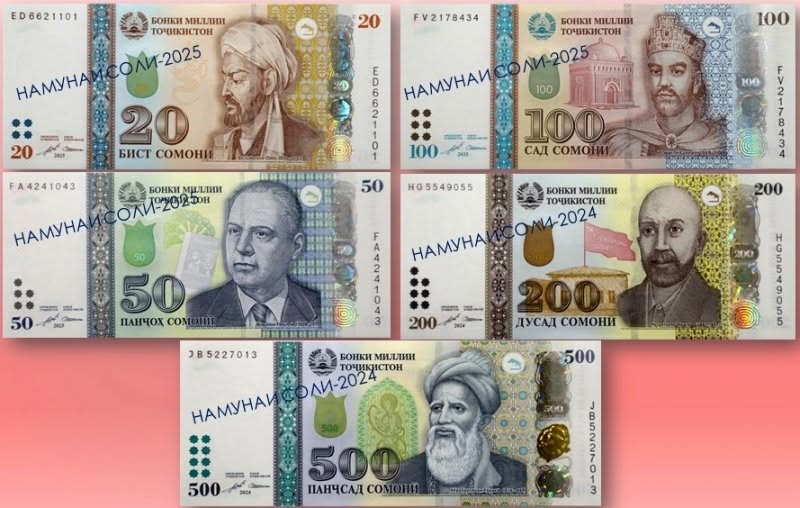
On October 30, 2000, a new monetary unit of the country — the somoni — was put into circulation. The national currency was named in honour of Ismail Somoni (849–907), the founder of the first centralized Tajik state. The choice of this name is symbolic from a historical and political perspective: the somoni refers to the past and conveys a message of statehood, sovereignty, and national identity to present and future generations.
— Money is the result of human labour and is considered one of humanity’s greatest inventions. It represents one of the fundamental components of economic science. Money plays a central role in the economy and is an essential element of the market. The role of money in society and its functions within the market economic system consist in serving as a connecting link between all economic relationships.
In the economy, prices and the value of goods are determined through money. The production of social products is organized through monetary relations. Money is also used to organize the formation, distribution, and utilization of national income through the state budget, taxes, and credit.
According to economic scholars, metallic coins first appeared in China in the 12th century BC as a result of the expansion of commodity production and exchange. Later, archaeologists discovered coins along the shores of the Mediterranean Sea dating back to the 6th–7th centuries BC. These coins were used in the states of Lydia and Aegina. They had identical weights, identical sizes, and identical designs. Gradually, coins acquired a circular shape, which made them very convenient to use.
Over time, alongside the development of production, the need for paper money emerged. Paper money has several advantages over metallic money:
— Paper money is lighter than metallic money.
— The cost of producing paper money is lower than the cost of producing metallic money.
From the time of its emergence to the present day, money has existed in two main forms:
- Real money;
- Substitutes for real money.
There are two theories concerning the origin of money: the rationalist theory and the evolutionary theory.
Supporters of the rationalist theory believe that money emerged as a result of exchange between people and on the basis of their mutual agreement.
The first founder of this theory was Aristotle. In his book, he writes: “To ensure exchange, there must be a certain unit of measurement (a measure of value), and this measure must be accepted by convention.”
Another economist, John Kenneth Galbraith, also states: “The establishment of the function of money for precious metals and other objects came about on the basis of agreement among people.”
Thus, representatives of the rationalist theory believe that money is a special commodity that emerged on the basis of mutual agreement between people.
The evolutionary theory presents a completely different view of the origin of money. Supporters of this theory believe that “money has a commodity nature and emerged independently of people’s wishes and intentions.”
The founder of the evolutionary theory is Karl Marx, who was able to prove the commodity nature of the origin of money. For a long time, people were unable to understand the essence of money and did not know what accounted for its enormous power.
Based on their research, scholars in this field have provided the following definition of money:
Money is a special universal commodity that performs the role of the general equivalent of all commodities and through which the value of other goods is expressed.
Before the emergence of money, a farmer who wanted to obtain a sheep had to take a sack of the wheat he had grown to a shepherd and exchange it for a sheep. This direct exchange process required a great deal of time and effort.
Gradually, two or three basic commodities were distinguished from among all goods and began to perform the role of equivalents (equal values) for other commodities. These commodities included animal skins, salt, livestock, and iron.
Later, over time, only processed precious metals and coins came to perform the function of money among commodities. These coins were made from various metals, such as copper, silver, bronze, and gold.
During the rule of the Samanid dynasty, metallic coins were also in circulation. During the Samanid era, there were more than 30 coin-minting centres. At that time, coins known as dinars (gold coins), dirhams (silver coins), and Ismailis were in circulation.
The peak of monetary circulation in the history of Tajik statehood occurred during the Samanid period. Numerous minting centres operated throughout the territory of the Samanid state, and Samanid dirhams were also used in circulation beyond the borders of the state.
If the Flag, Emblem, National Anthem, and state language represent the national and spiritual values of a state, then the national currency is one of its most important economic and financial symbols.
The national currency enables a state to implement its own monetary and credit policy through the relevant institutions, regulate the amount of money in circulation, influence inflationary processes, organize the activities of the banking system, and, when necessary, implement financial and monetary measures in accordance with the interests of the national economy.
For every independent state, the national currency is not only a means of economic exchange but also a symbol of its political and economic independence. For the Tajik people, the national currency, the somoni, represents a return to historical statehood, national pride, and the prestige and dignity of the state and nation.
The first paper money issued in Central Asia, which, like silver coins, was called “tanga,” dates back to the final years of the reign of the last Emir of Bukhara, Said Olimkhan. Paper banknotes with denominations of 20, 50, 100, 300, 500, 1,000, 2,000, 5,000, and 10,000 tangas were put into circulation.
In September 1920, the Bukharan People’s Soviet Republic was established in the territory of the Emirate of Bukhara. It continued issuing the same paper money introduced by the emir, with only minor modifications. In particular, the inscription “Issued by the Supreme Imperial Decree” in the upper circle was replaced with Soviet symbols — an image of a sickle and a sheaf of wheat — and the names and positions of officials were changed. The entire text on these banknotes was written in the Tajik language.
Until 1925, there were no banking institutions in the territory of Tajikistan. The need to establish an independent banking institution arose with the creation of the Tajik Autonomous Soviet Socialist Republic, after which the State Bank of the Union of Soviet Socialist Republics was established. The modern banking system was established after Tajikistan gained independence on September 9, 1991, and the National Bank of Tajikistan was created.
During the first years of independence, Tajikistan was in an extremely difficult political and economic situation. Under these circumstances, dependence on an external monetary system restricted the country’s ability to pursue an independent economic policy. Although the Republic of Tajikistan gained independence in 1991, Soviet-era supplementary currency remained in circulation within the republic until the end of 1993, and later, from January 1, 1994, cash currency of the Russian Federation circulated there.
Tajikistan remained the only country among the newly independent states where the Russian ruble continued to be used in circulation until 1995. This situation created a number of serious socio-economic problems: the republic’s public debt increased because of a shortage of cash needed to pay salaries, pensions, and benefits for vulnerable groups of the population; economic financing was practically halted, and the National Bank of Tajikistan had no opportunity to conduct an independent monetary, credit, and foreign exchange policy. Resolving these and other problems made the introduction of a national currency necessary. Therefore, establishing a national monetary system became one of the most important tasks of state-building.
Thus, in order to implement an effective economic policy, accelerate economic transformations, and establish an independent monetary system in Tajikistan, a decision was made to introduce the national currency of Tajikistan on the personal initiative and with the support of the respected President of the Republic of Tajikistan, Emomali Rahmon.
The first step in this direction was taken on May 10, 1995. On that day, the Tajik ruble was introduced into circulation as the national currency of Tajikistan. The Tajik ruble remained in circulation for approximately five years. During this period, the necessary experience was gained to establish an independent monetary system, strengthen the banking system, and prepare the foundations for the transition to a new national currency. From a historical perspective, the Tajik ruble represented an important stage on the path towards the introduction of the somoni.
Following the stabilization of the country’s political and socio-economic situation after the signing of the General Agreement on the Establishment of Peace and National Accord in Tajikistan in 1997, opportunities to move to a new stage of economic reforms increased significantly.
In accordance with the Resolution of the State Commission of the Republic of Tajikistan on the Introduction of the National Currency dated May 6, 1995, “On the Procedure for Introducing the National Currency — the Tajik Ruble — into Circulation in the Territory of the Republic of Tajikistan,” the national currency of Tajikistan was introduced into circulation on May 10, 1995. During its five years in circulation, this monetary unit played an important role in establishing the foundations of the country’s economic independence and created the necessary conditions for the beginning of a new stage of development.
With the establishment of political and economic stability in the country, in 1999 the National Bank of Tajikistan signed an agreement with a reputable German company to produce the national currency, which was intended to reflect the historical past and contemporary culture of the Tajik people.
By Decree of the President of the Republic of Tajikistan dated October 26, 2000, the new monetary unit of the country — the somoni — was introduced into circulation on October 30, 2000. It was named in honour of Ismail Somoni (849–907), the founder of the first centralized Tajik state.
In the Republic of Tajikistan, monetary reform consists of two stages:
- May 10, 1995;
- October 30, 2000.
For Tajikistan, the national currency — the somoni — is a means of payment and economic exchange, an embodiment of the difficult and complex path towards the country’s independence, a symbol of statehood and national pride, a link between the nation’s present and past, and one of the clearest indicators of economic independence. The name of Ismail Somoni — the founder of the centralized Samanid state — is immortalized on the somoni. The choice of this name has symbolic historical and political significance: the somoni refers to the past and conveys a message of statehood, sovereignty, and national identity to present and future generations.
The somoni features images of prominent figures from Tajik history and culture, architectural monuments, works of art and craftsmanship, and other elements of cultural heritage. Thus, money performs another function in people’s everyday lives: it presents the history of a nation to millions of people. Anyone who looks at the somoni can observe historical heritage, portraits of scholars and great figures of the nation, as well as national and cultural symbols. The somoni can also be considered a kind of cultural passport of Tajikistan.
This characteristic is particularly important for the younger generation. A young person who knows the history of the figures depicted on the national currency should understand that every image and every symbol has been chosen deliberately. Therefore, citizens’ attitudes towards the national currency are one of the foundations of mutual trust in the economy. When a citizen accepts the somoni, they trust it as a legal means of payment; when a bank holds it, it effectively preserves part of the financial system; when the state puts it into circulation, it fulfils its responsibility to the national economy.
Disrespecting the national currency or deliberately damaging it is incompatible with civic culture. The national currency is not merely the personal property of one individual; it is part of the country’s overall national economic system. At the same time, attitudes towards the national currency should be explained through legal and economic education.
Studying the history of the somoni can become an important part of the economic education and patriotic upbringing of young people. Young people should know why Tajikistan needed a national currency, what role the Tajik ruble played, why the name “somoni” was chosen, which historical figures and monuments are depicted on the national currency, and what significance monetary and credit policy has.
When an employee receives a salary, an entrepreneur sells products, a student pays everyday expenses, a citizen pays taxes, or a family saves money, the somoni plays a role in all these economic relationships.
Every entrepreneur, through the development of production; every employee, through high-quality work; every student, through education and the acquisition of knowledge; and every citizen, through a responsible attitude towards the country’s economy, can contribute to strengthening economic independence.
Therefore, the national currency is both a symbol and an active mechanism of statehood.
According to Article 69, Clause 15 of the Constitution of the Republic of Tajikistan, the President “determines the monetary system and submits information to the Majlisi Milli and the Majlisi Namoyandagon.”
The national currency truly becomes strong when the national economy is productive, competitive, and efficient. This happens when domestic products can supply both domestic and foreign markets, when citizens possess financial literacy, when the banking system meets the requirements of the times, and when confidence in economic institutions remains strong. Protecting and properly using the national currency is the responsibility of every citizen. We must use money respectfully and carefully and contribute to the development of our country’s national economy. After all, protecting the somoni is a shared duty and responsibility of society as a whole.
Today, the somoni embodies three important meanings: an economic instrument, a symbol of statehood, and an element of national identity.
The new paper banknotes feature portraits of great contemporary and historical figures of the Tajik people, as well as images of Tajikistan’s architectural and historical monuments and objects of Tajik folk art and craftsmanship. Today, the somoni is considered one of the stable currencies in the world. Respect for the national currency is a civic duty, and respect for the national currency means respect for the state and the nation, independence, and the prosperous future of Tajikistan.

0 комментария к “THE HISTORY OF THE ORIGIN OF THE NATIONAL CURRENCY Respect for the national currency is respect for the nation!”