
Statistical accounting is considered to be an effective means of systematization and development of prospects for the activity of economic entities.
Emomali Rahmon
SUSTAINABLE DEVELOPMENT OF THE AGRICULTURAL SECTOR: GROWTH IN PRODUCTION AND STRENGTHENING OF LIVESTOCK RESOURCES IN TAJIKISTAN
18.05.26
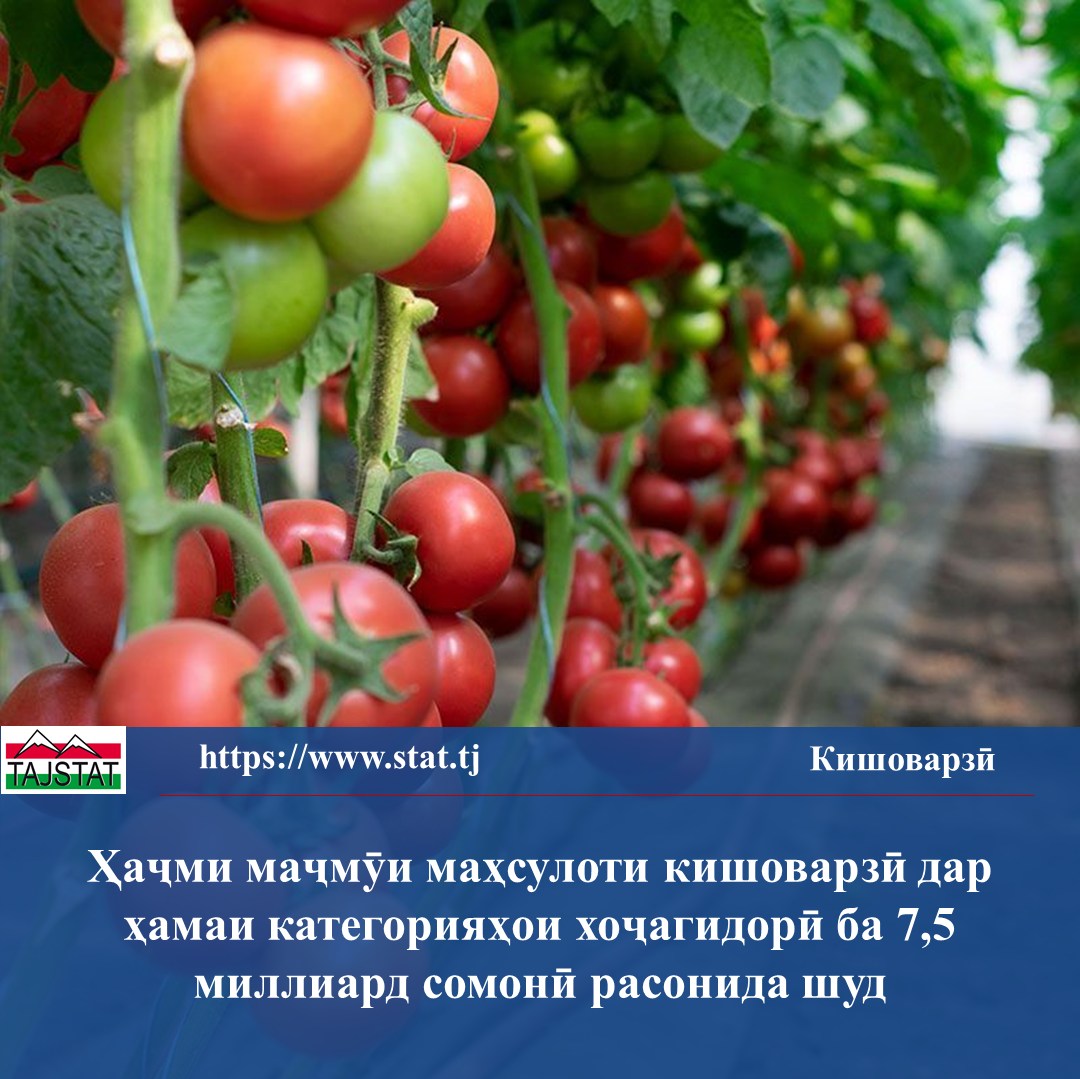
In January–April 2026, the agricultural sector of the Republic of Tajikistan continued its positive development, with the total volume of agricultural production across all categories of farms reaching 7 billion 561.4 million somoni. According to statistical data, this indicator increased by 7.1 percent in comparable prices compared to the same period in 2025.
Analyses show that the development of the agricultural sector is primarily linked to the efficient and rational use of land, improvement of agricultural practices, expansion of fieldwork, state support for agricultural producers, and the implementation of sectoral reforms.
In addition, the introduction of reforms in the state statistical system, improvements in data collection methodology, digitalization of statistical processes, and better coverage of business entities in statistical reporting have also contributed to increasing the transparency and accuracy of sectoral indicators.
Of the total agricultural output, livestock production accounted for 6 billion 633.2 million somoni, representing an 8.4 percent increase compared to the same period last year. Meanwhile, crop production amounted to 928.2 million somoni, declining by 1.7 percent due to seasonal factors, changes in planting schedules, and climatic conditions at the beginning of the year.
In the overall structure of agricultural production, household farms accounted for the largest share, representing 71.2 percent of total output. This figure reached 96.4 percent in the Gorno-Badakhshan Autonomous Region, 73.3 percent in Sughd Region, 67.4 percent in Khatlon Region, and 73.6 percent in the districts of republican subordination. Collective farms accounted for 14.2 percent, while dehkan farms represented 14.6 percent.
During the reporting period, all categories of farms produced 3,342 tons of potatoes, 86,630 tons of vegetables, and 2,059 tons of fruit. Compared to the same period last year, potato production increased 4.4 times and fruit production increased 1.8 times.
One of the key indicators of sectoral development is the growth in livestock numbers. As of May 1, 2026, the number of cattle in all categories of farms reached 3 million 69.7 thousand head, an increase of 261.5 thousand head or 9.3 percent compared to the same period last year. The number of sheep and goats also reached 8 million 214.1 thousand head, increasing by 11.7 percent.
The increase in livestock numbers is linked to the implementation of state support measures, improvements in fodder supply, the development of household and dehkan farms, as well as livestock inventory activities carried out by state statistical authorities and the regular work of local statistical agencies. Improving the accuracy of livestock accounting and ensuring full coverage of farms in statistical reporting create favorable conditions for reflecting the real sectoral indicators.
In the overall livestock structure, household farms account for the majority share: 94.3 percent of cattle and 81.6 percent of sheep and goats are concentrated in this sector.
The production volume of meat from large and small livestock across all categories of farms reached 68,017 tons, which is 12.5 percent higher than in the same period last year. Meat production increased by 16.1 percent in Sughd Region, 10.7 percent in Khatlon Region, and 12.4 percent in the districts of republican subordination.
At the same time, poultry meat production reached 14,396 tons, increasing by 11.3 percent compared to the same period last year. Analyses show that the development of the poultry sector has been supported by expanded production capacities and growing market demand.
During the reporting period, milk production in all forms of farming amounted to 300,149 tons, increasing by 4.3 percent compared to the same period last year. Egg production reached 415 million 366 thousand units, increasing by 2.3 percent.
Wool production amounted to 1,829.5 tons, which is 1.9 percent higher than in the same period last year. During this period, 520,428 calves and more than 2 million 704 thousand lambs and kids were also born, representing increases of 2.1 percent and 4.7 percent respectively compared to the same period last year.
Overall, the results of January–April 2026 demonstrate that the agricultural sector of the Republic of Tajikistan continues on a path of sustainable development through the effective use of available opportunities, implementation of sectoral reforms, improvement of management efficiency, and enhancement of the statistical system.

0 комментария к “SUSTAINABLE DEVELOPMENT OF THE AGRICULTURAL SECTOR: GROWTH IN PRODUCTION AND STRENGTHENING OF LIVESTOCK RESOURCES IN TAJIKISTAN”